Sunday, November 6, 2022
Three Books That Broke the Reading Drought, Part 1
Wednesday, September 21, 2022
Art Imitates Art: Poetry Postcard Fest 2022 Wrap-Up
| Cards I got from other Festers. Go, Group 9! |
The annual August writing marathon is done—30 days, 31 poems written on 31 hand-painted postcards and mailed off to other poets and artists around the country (and one in the UK). This was my 10th year doing the August Poetry Postcard Fest, and as always, it was… different than other years. It’s different every time; it grows and morphs around what’s happening in the rest of my life, and in the world. This year, the writing came easy. I rarely was stuck for an idea, and I didn’t feel the usual peevish rebellion about having to write on a schedule, even though it was also a really busy month at work. Every few evenings I’d write three or four poems, and then I'd take a few days off. I like that pace with short postcard poems, which tend to ripen better in batches or something.
Serial and random
I started out the Fest bent on seriality. Weeks earlier, I knew exactly what I wanted to write about: I’d turned 60 a few months earlier, and it was weirding me out. I just could not believe I was 60. I know lots of people in their 60s who suddenly got hernias and prolapsed bladders and tumors. When I think of 60 I see washed-out gray, stooped, moving slowly. Possibly shaking a rolled-up newspaper at a kid riding a bike too fast. 60 has moved in like a houseguest I didn’t invite and will not leave. I guess I’ll have to make my peace with 60; in the meantime, I plan to kayak the hell out of it.
So the first few poems of the month were all about 60—puns and visual images of the number, free-associated strings of maladies and misery. But by about the fifth poem, I could feel that I wasn't making any peace with 60, and not even very much sense. I’m not sure any of those poems are keepers. So I moved on to other ideas.
After that there were a lot of random poems, experiments, some of which turned colors and boiled over, which is good, and some of which didn’t. Two of my favorites were about black widow spiders. I always seem to write about black widows during August, since they’re in the crooks and corners of patios and garages around here, growing big and shiny in the sweltering heat and knitting their cottony egg sacs. Of course their ferocity is legendary, but in reality they’re mostly timid and serene. I always get a lot of poetic mileage out of black widows.A game of 20 extras
This year I again hand-painted all of my postcards. I love that ritual, and I have to get an early start on it; I was painting the cards back in May or June so I could paint three or four at a time and then take a few days off (same as the writing). This year I used mostly Strathmore watercolor postcards; after experimenting last year, I settled on Strathmore as a good compromise between durability and quality. (Plus Strathmore used to have a mill in Westfield, Mass., where I lived, and they were a big employer there.) I also used a few scraps of cotton paper, always my favorite for watercolors, but cotton feels too pliable to send naked through the mail, so I popped those into envelopes so they wouldn’t get scuffed.
![]() |
| A keeper. Can’t go wrong with Prussian Blue. |
Some of the paintings I especially liked this year were monochromes and duochromes, abstract landscapes using just a couple of watercolor techniques—wet-in-wet gradients and dry brush, with some scraping and scratching. I had a lot of fun with those and kept a bunch.
![]() |
| I painted this one for a specific poem. A bit like being a kids' book illustrator. |
Mirror, mirror … never mind
This year I tried something new: painting postcards specifically for the poems, and also the reverse—writing ekphrastic poems about my own paintings on the postcards*. I sort of liked painting to complement the poems; that was a free-wheeling exercise in abstraction, or in surreal representation. But I didn’t like writing ekphrastic poems about the paintings; that felt weirdly self-referential, a kind of narcissistic loop. Like, I painted this somewhat abstract landscape, and now I’m writing a poem about it. It was a sham, a trick I was pulling on the reader—a made-up poem about a made-up visual scene. It was like trying to build a house on air. There didn’t seem to be much point to it.
One of my favorite poems of the month was about a baby that someone at a party asked me to keep an eye on for a few minutes. We were outside, it was raining a bit, the baby was sleeping in a little covered hammock—and suddenly the world exploded into metaphors. That was way better than any made-up landscape. There’s something to be said for writing poems about real things. This was a good reminder of that.
* Coincidentally, I just did a (live! in-person!) reading here in Ashland with my friend Allan Peterson, a renowned poet and longtime visual artist and art professor. During the Q&A after our reading, he said that he has no desire to pair up his poetry and artwork—say, in a book of his poems and paintings—because then the writing and painting “will be trying to explain each other.”
Recently Allan asked how my art was coming along, and I said I’d become so engrossed in painting small postcards that I hadn’t painted much of anything else recently. He said he once had a student who felt she’d confined herself too much by always making small paintings, and he advised her to “use bigger brushes.”
Saturday, December 25, 2021
A Year of SketchBox
A year ago, I decided to try SketchBox, a subscription service that sends you a small box of art supplies every month. I’d been taking a series of Zoom painting classes that had just ended, and I was worried that art would drift out of my life if I didn’t have some stimulation coming in regularly to challenge me. (I’m the kind of person who never goes to the gym unless a tennis partner or class instructor is waiting for me, foot tapping with impatience.)
There are lots of these subscription companies—ArtSnacks, ScrawlrBox, and Let’s Make Art, to name a few—but I decided on SketchBox because the ads had beautiful art, the materials seemed varied and high-quality, and it wasn’t aimed at kids; there were no hobbit houses or cartoon dogs in the ads. SketchBox has two tiers—a Basic Box at $25/month + $5 shipping, and a Premium Box at $35 + $5, which has everything from the Basic Box plus a few extras. I sprang for the Premium Box because I knew I’d always wonder what extras I was missing out on if I got the Basic Box. I steeled myself for that $40/month payment; I’m not made out of money, and this seemed like kind of a loony extravagance. But I didn't have any more painting classes lined up, I was curious about SketchBox, and I knew I could cancel it at any time if it wasn’t my thing.
And now it’s a whole year later, and I’ve received a full year of SketchBox boxes. What's the verdict?Read on.
What I love about SketchBox
• You don’t know what will be in each month's box. No clue. I didn’t think I’d like that—you’re shelling out $40 a month, and you don't know what you're getting? But they smartly send you an email when it’s shipped, and that gives you 3–5 days for the excitement to build, and then it arrives, and—I’ve got to say, it’s exactly like getting a Christmas present. Every month, I tore into that box with glee. Not knowing what to expect makes it . . . better.
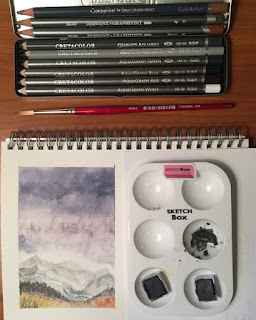
| The February box was tinted graphite. |
• With every box you get a link to an online video tutorial showing you how to use everything in the box. This was great—full of tips and techniques. (Ask me all about swatching.) Some other box subscriptions offer instructions in magazine format, but I would much rather have a video. I only wish they were a little longer.
• SketchBox usually includes a pad of paper, again often from Europe or Japan. Some other subscription services don’t do this; I’m sure it reduces their costs and subscription fee, but I love trying out different papers. My one quibble is that the paper is always 4 inches wide to fit in the SketchBox shipping carton. I'd love to occasionally get a larger pad, 6x9 or 8x8.
• One of my favorite things has turned out to be the SketchBox online community—it's large and active, and those connections have led me to other opportunities. Through posting and tagging my artwork that I made with the SketchBox supplies, I've found other SketchBox artists on Instagram, who talk about online instructors they like, many of whom have free tutorials on Youtube. And because several of my new Instagram contacts are in Germany, their posts are in German, and so are the video tutorials they recommend—which gives me a chance to brush up on my German, something else I haven’t used in 30 years.
Not so hot
Did I love every one of the 12 SketchBoxes I got this year? Honestly, no. There were a few supplies that didn’t grab me. I’ve tucked them away in hopes that I'll warm to them one day, and because SketchBox tends to mix supplies, no box was a complete fail; there was always something I liked in it. But for me, the duds were:
• Alcohol markers. These are very hot right now, and some artists do amazing things with them. I’m just not one of them, and don’t have much patience for these. They also require special paper that they won’t bleed through. And they smell weird, like slightly dangerous fruit juice.
• Oil pastels. One summertime box was all about oil pastels, five colors in very nice European brands, along with three small canvases. But I just can’t with oil pastels. They’re messy and inexact. And they also smell funny, like old crayons.
• Metallic and pearlescent paints. These seem to be popular, but I’m not sure why. Sure, you can paint something cool with them—you can mix colors just like any watercolor—but then you turn it to the light and go, “What the f***—why so glittery?” I'm clearly the wrong audience for these.
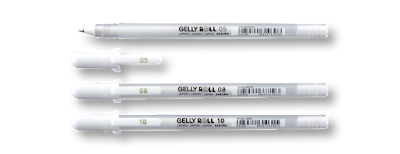
| Accept no substitutes. |
Seemed silly; ended up cool
• Every once in a while, a SketchBox includes . . . a pencil. Usually a European-made one, kinda fancy. I laughed the first time I got one, rattling around loose in the box—like, who doesn’t have a jillion pencils? But I've come to really like these. Some have hard lead and are good for light sketching that won’t show under a watercolor. Others are dark and smooth and are good drawing pencils all by themselves. There’s something to be said for good pencils, and they now have a special place in my drawer. I feel a certain calm reverence when I use a pencil made in Switzerland.
| Get one. Seriously. |
• All of the brushes. Come on, if you’ve painted for any time at all, you probably have about a thousand brushes. But SketchBoxes often include one lone brush, an unusual shape or size that I probably wouldn’t normally buy—a chisel blender, a dagger, or a filbert—because they’re sort of luxurious and unnecessary. The kind of thing you might get—wait—as a Christmas present! I love them all now.
Dreaming on
To conclude, I loved this year with SketchBox. And I don’t feel like I’ve quite had my fill of it, so I’ll continue my subscription for a while. I figure they’ll probably start repeating themselves at some point, but I like to think about what surprise might be in the next box. And there are a few things I wish they’d include, done up SketchBox-style, a fancy European or Japanese version of:
• Kneaded eraser
• Sand eraser
• More mouth-watering watercolors from Stoneground
• Samples of European watercolors I’ve been wanting to try: Gallo, Roman Szmal, Nevskaya Palitra, Sennelier, Maimeri
• Fountain pen
• Nib pen
And sticking with SketchBox will keep me from trying those non-art subscription services that now keep popping up in my Facebook feed like weeds—international snacks, cosmetics, coffee, spices, whisky. (Wait—the whisky one. Hmm . . .)
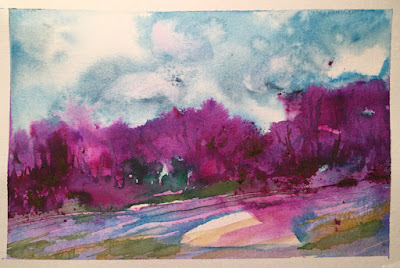
| Made with the November box—Gansai Tambi watercolors and Color Sparx Watercolor Powder. |
* Many watercolorists shun this—adding white with a marker or gouache. Personally, I’ll only do it if the painting isn’t working and I’ve screwed it up somehow; then I’ll have at it with whatever markers are at hand just to see what happens. I’ve actually ended up with some good paintings this way.
Wednesday, November 3, 2021
Inktober: Shut Up and Draw
![]() |
| Does an embarrassing clutter of markers make you draw more? In a way, yes. |
So I was thrilled to find that in the world of art—which I’ve recently rejoined after a long and bitter absence (future blog post)—there are also marathons. And this past month I decided to try one: Inktober*, a 30-day sprint where thousands of people from all over the world draw or paint a piece of ink artwork every day and post it on Instagram (#inktober2021). Back in my youth, drawing in ink was my thing, so I was eager to give this a try. I wondered: Could I keep up with a drawing a day? Would it energize me, or make me hate art all over again? And what, in today’s avalanche of art supplies, qualifies as “ink”?
I gathered everything in the house that had ink in it—fistfuls of pens, markers, India ink, even a Cross fountain pen that I bought in a closeout sale three years ago and hadn’t had the guts to take out of its package, it was so unapproachably pretty. I also snuck in some bottles of liquid watercolor, which felt like cheating but oh well. I chucked it all onto an end table in the living room and piled even more on it over the course of the month, my own Inktober hazmat site.
So, how’d it go? Pretty good. I drew almost every day. Okay, I skipped about 10 days, but I tried not to sweat that; not sweating things turned out to be one of the themes of my marathon. I ended up with about 20 new pieces of art, including a few that I’m proud of.
During the month of drawing, I had a lot of thoughts—some ups and downs, many times when I almost bailed, and a lot of late-night pondering over the connections between visual art and poetry, different animals on the artistic family tree that still share some genes. So, observations:
“Inking” is actually drawing.
I had to laugh at this. Around day 5, I realized that I’d started the marathon with some lofty notion that “inking” would mean just grabbing a fancy pen or some brush markers and whipping up some instant art, a happy little miracle every evening. But I found out I’m too much of a mechanic for that; I preferred doing a pencil sketch first and then inking over it. The few spontaneous doodles that I did were my least favorite pieces of the month—they seemed inert, uninspired. But the drawing thing became an unexpected visit with an old love—I adored drawing in my teens and 20s; then, after some art trauma, I lost my confidence in drawing and didn’t do it for decades. But after this past month of drawing pears and apples and trees and cows and horses and houses and mountains, I now feel like I actually can draw again, like I want to. The muscle memory of it is still there, still in my hands; in fact, with my older brain, I seem to be better at it, better at seeing shape and value. I am, in particular, better at pushing the darkness (a metaphor on a platter). And luckily, the joy is still there too.
To keep drawing, I had to fight my own fragility.This is one way that Inktober was different than a poetry-writing marathon—it turns out I have all sorts of confidence in my poetry, but almost none in my visual art. I’ve been doing poetry for a long, long time, and I’ve written so much and had so many poems published and rejected that I can write a crappy poem one night and completely forget it about by the next day; I know there will always be another poem. But the same wasn’t true of drawing; if I did a drawing one night that I didn’t like, I felt melodramatically wounded—absolute despair, like it was all over and I should just give up. This happened several times early in Inktober; I’d draw and post something that I wasn’t happy with, and it would haunt me into the next day: Well, there it is—I’m a crappy artist, and now the whole world knows. Luckily, by the next evening I’d usually get the bug to try something different—thank you, pile of art supplies on the end table—and that night’s drawing sometimes turned out OK. And the pendulum would swing the other way—Hey, this came out cool, so maybe I’m good at some things. Or even I like that color. By the end of the month I was very aware of those swings and was consciously trying to even them out. I realized that the fragility was a result of the Great Art Trauma in my 20s—a time when I decided I was a bad artist and feared showing that to the world—and the marathon became a way of working through some of that. And some of the drawings I didn’t initially like grew on me over time; they weren’t what I set out to do, but once I let go of that, they didn’t seem so bad.
The brain wants to get all up in art’s business.
I would start drawing, and my brain was clicking away. I could feel it, trying to control my hand. Careful. Don’t be derivative. That’s too Miro; people will notice. Don’t try that again—you’ve drawn so many bad horses! And then, without my noticing, that language center would shut off. Things got very quiet, and for a while I was all body—my hand scratching at the wet ink, flicking grass or branches onto the paper, my face contorted, my voice whispering to itself—rounder, darker, right here. I would sit back and see the balance of the scene, see what it still needed. It felt just like I was playing deep into a tennis match—all motion, intent, instinct, the body doing what it knows how to do. It was also just like being in the middle of writing a poem—the editor had fled and the subconscious was now driving; that’s always the interesting part. Oh, the brain came back later to criticize what I’d drawn, and sometimes it hurt me. This is a place where art and poetry differ: A poem can always be changed, but ink is pretty much forever and leaves an ugly stain when you try to fix it.
Drawing/painting takes longer than writing poems.
I got tired during Inktober. Really tired. Every night—even if I set out to draw/paint something simple, like a pear—I ended up spending at least an hour on the piece, and often longer. And afterward I’d be so wired that I wouldn’t be able to sleep. And it was a busy month at work, so I was already tired in the evenings. Toward the end of the month I felt sleepy every day by late afternoon. My system for writing every night during poetry marathons works better; somehow I can predict how much time it will take and compensate for it so I don't get exhausted. So that needs some thought. And, riffing off that …I’m sort of lucky I survived.
By that I mean, all that staying up late and drawing when I was half awake probably wasn’t conducive to great art.** And by all rights, bad art should have finished off my fragile ass (see above). However, Inktober made me try out markers and pens and notebooks and pencils, and it forced me to go through my own reference photos (which I take all the time on drives around town) and raid them for things to draw. It was a month of experiments, and I found a few things that I unexpectedly seemed to be good at (and a few that I just liked doing). And in a way, doing that every night produced the same results you get—if you’re lucky—after receiving umpteen rejections of your poems for umpteen years. You stop caring so much about each rejection, because you know you’ll write again and will send stuff out again. Same thing with this art marathon; the next night, there was another pen, another fistful of markers, and another picture in my head. And I tried again. And that was maybe the best thing about Inktober—all those days to try.
* Another thing I found out this past month is that the art world, like the poetry world, has its scandals and infighting. Apparently the guy who owns the trademark to Inktober was accused of plagiarizing another artist's educational writing, and it caused a split in the art world; some artists now refuse to participate in Inktober and have spawned all sorts of rival marathons. So that gives me something else to check out next year.
** This is a debate that poets often have about NaPoWriMo: the argument that if you have to crank out a little ditty every day, how good are the ditties going to be? I understand that viewpoint—and I used to share it—but I found that NaPoWriMo serves a purpose for me, if only to shake up my usual writing practice and to force myself to write when I don’t feel like it, which results in interesting themes and forms. I always figure if I can get four or five decent poems out of the 30 that I write during NaPoWriMo, that’s a fine return on my investment. And I end up with stumps of weird stuff that sometimes serve as sparks for other poems later.
Saturday, September 4, 2021
Poetry Postcard Fest 2021: Both Sides Now
| All the postcards I received this year, plus a bonus Buckley. |
This year, the annual August writing marathon attracted more than 500 participants from 13 different countries. My group (go, Group 8!) had 33 people in it, and I ended up writing 33 poems—32 to the other people in the group, and an extra card to someone else.
Side 2: The postcards
This year, I took a totally new approach with the actual postcards: I hand-painted all of them. In past years I’ve used giveaway postcards from restaurants, touristy ones I picked up at the drugstore, and ones I got printed at Vistaprint with my own photos on them. But I’ve been doing a lot of watercolor painting this past year, and I was intrigued by the idea of painting each one individually. In retrospect, that sounds kind of nuts—paint 33 individual paintings?—but I was already thinking of it back in April or May, so I started painting them then. I tried out lots of different paper—postcards made for watercolor by Daniel Smith, Hahnemühle, Schmincke, and Strathmore, and also 4x6-ish pieces of heavy watercolor paper by all sorts of companies. Pretty much anything I ran across the past few months that seemed like it would hold up in the mail. I ended up putting a few in envelopes, especially if the paper was 100% cotton; it seemed too soft not to get torn in the canceling machines.
Bonus track: The community
Once again, the PoPo Fest’s Facebook group was really fun to keep up with all through August. People take such different approaches to the postcards; some do collages, one person used grocery cartons (she sent me one made from a Kleenex box). Some found vintage postcards; one woman in Alabama sent me an old postcard featuring a building in my town in Oregon, which amazed me. And many, many others didn’t really care about the postcards; for them, it was all about the poems. I’ve done it lots of ways over the years, and they’re all good; the PoPo Fest is flexible enough to accommodate pretty much any way you want to do it.
* Here are a couple of PoPo poems that did get published:
Thursday, December 31, 2020
The Writing Year: Get thee behind me, 2020
![]() |
| Derailed subway train in the Netherlands saved by a whale sculpture, 11/2/20. Seems like an apt metaphor for the year. |
Zoom poetry events: some good, some bad.
Seeing friends read in other cities—amazing! Seeing famous poets whose voices I'd never heard—fantastic! Attending open mikes with readers from other countries—transcendent! Going to online poetry conferences...um...
I wrote a lot about the pandemic.
I journaled to preserve the strange, disaster-movie quality of it all: the sudden shutdowns and surreal speed of it, the news from overseas, the appalling lack of response from the U.S. government, the rumors, the social divisions. It felt important to chronicle these things. I also wrote a shit-ton of pandemic poems early on, some of which I posted on Instagram with graphics, which was an empowering, absorbing project. I published some others in journals and anthologies. Some poet friends, I know, didn’t write at all about the pandemic. I totally hear that (see the next paragraph); I just felt compelled to make bread with the dough at hand, and pandemic dough was what I had.
![]() |
I’ve been working at home full time since March 17 (and am so grateful to be working), and I still never feel like I have enough time to write. It turns out working at home in sweats is still working. I still really look forward to weekends.
This surprises me, how much I miss the after-reading drink with a few friends at the pub. The big group walking to the restaurant for a meal with the famous poet who’s in town for one night. The random meet-ups in the hotel bar after a long day at the conference. The dinner with a poet friend where we talk about sequencing manuscripts and have a bit too much to drink and laugh our asses off. Writing is great, but being a poet is also about living in a world.
Because my hair is much longer now. I wasn’t identifying with the photos taken a couple of years ago, the short-hair ones. Is this isolation some kind of chrysalis? Will some of us emerge with antennae and tails? Will that be a wonderful thing? The pragmatist in me says Stop it. Cruel. Crass. The writer in me says…wings.
Netherland subway train photo by Robin Utrecht/Getty.
Almeda fire photo courtesy of Governor Kate Brown's office.
Wednesday, April 15, 2020
NaPoWriMo, Plague Year Edition
![]() |
| I got an early start on NaPoWriMo by writing Instagram poems in March. Let's just say there was a theme. |
Hard syrup
So, how’s the marathon going? I won’t lie to you, reader; this one's been a slog. I haven’t had a single good patch of days where the poems were flowing freely; this year they’re all feeling sort of extruded, like old maple syrup that you have to squeeze really hard to get out of the bottle. Most years, there are a few days like that. But this time, it’s every day—a steady diet of hard syrup.
Of course, this year is different. Everything is different. We’re all carrying the immense weight of the Coronavirus pandemic, a horror show that keeps morphing with its shutdowns and layoffs and fevers and ventilators and shortages and epic presidential incompetence, and so many of us are waiting it out at home, isolated and bewildered. (For my part, I'm working at home, extremely grateful to still have a job, and staying away from people as much as possible.) There’s no guidebook for how to live and be during something like this, let alone try to keep up a writing practice. I see writers on social media talking about how they haven’t been able to write at all, and others saying how all their writing is doom and gloom and mostly cathartic, or they find themselves writing chirpy upbeat nonsense that even they don’t buy. On Twitter I’ve been reading good advice that people are getting from their therapists and counselors, and most of it boils down to this: You are going to feel all the feels, and many at the same time. Whether or not you choose to make art out of this (or substitute “be productive” or “stay positive”) is up to you, and there’s no one way; we’re all learning this, and because it’s grief, it will take its own path through you. Just know that it will.
Getting out there, metaphorically
But I had a poetry-writing marathon to get on with, and I realized that the pandemic felt a lot like the choking wildfire smoke we've had for weeks at a time in southern Oregon in recent summers. I was writing a lot then too, and all I could write about was that damned smoke; it was literally in my face, constantly. The pandemic is functioning like that as well, but of course everyone, everywhere, has it in their face. As with the smoke, I felt like I needed to break the current crisis down into small increments, micro-scenes of my own everyday life; it’s too vast and overwhelming—not to mention still developing—to take on much more than that in a single poem. And the whole thing is surreal, isn’t it? Like a dream that you’ll wake up from and think, Whoa, that was nuts.
I started writing poems about the pandemic back in March, before NaPoWriMo began, because the emergency was beginning to hit us locally and hard. And I decided early on to post a lot of them on Instagram (@amymillerpoet). I’ve been dabbling with Instagram poetry the past few months; I like the mixture of text and images, the block of art. The whole thing about how the poem is now published because I went and blabbed it on Instagram is just another interesting thing; I’m not sure what to do with that. But suddenly it felt like a time to let the poems walk out the door, since I literally couldn’t. We are truly all in this together, and I had a strong compulsion to get poems out in the world where all sorts of people could read them, not just the ones who subscribe to literary journals. And, I don't know, maybe I just needed a gigantic distraction. The discipline and techie geekiness of making those Instagram poems was like a lifeline I was following through some very dark water.And now that NaPoWriMo is halfway through, I’m continuing to write and post some Instagram poems; the impulse to put together words and images is still strong. So maybe NaPoWriMo has felt like a slog because I was already tired from writing a poem a day in March, more or less. But, like I used to say about the great NBA player Tim Duncan, what made him great was that he kept going on bad days too; he just changed his game a little. So I’m still welcoming the daily discipline of NaPoWriMo, even if it hurts more than usual. I’m still hoping to hit a few three-pointers.


